
“KILL IT FOR THE MOUTHFEEL” | artist essay
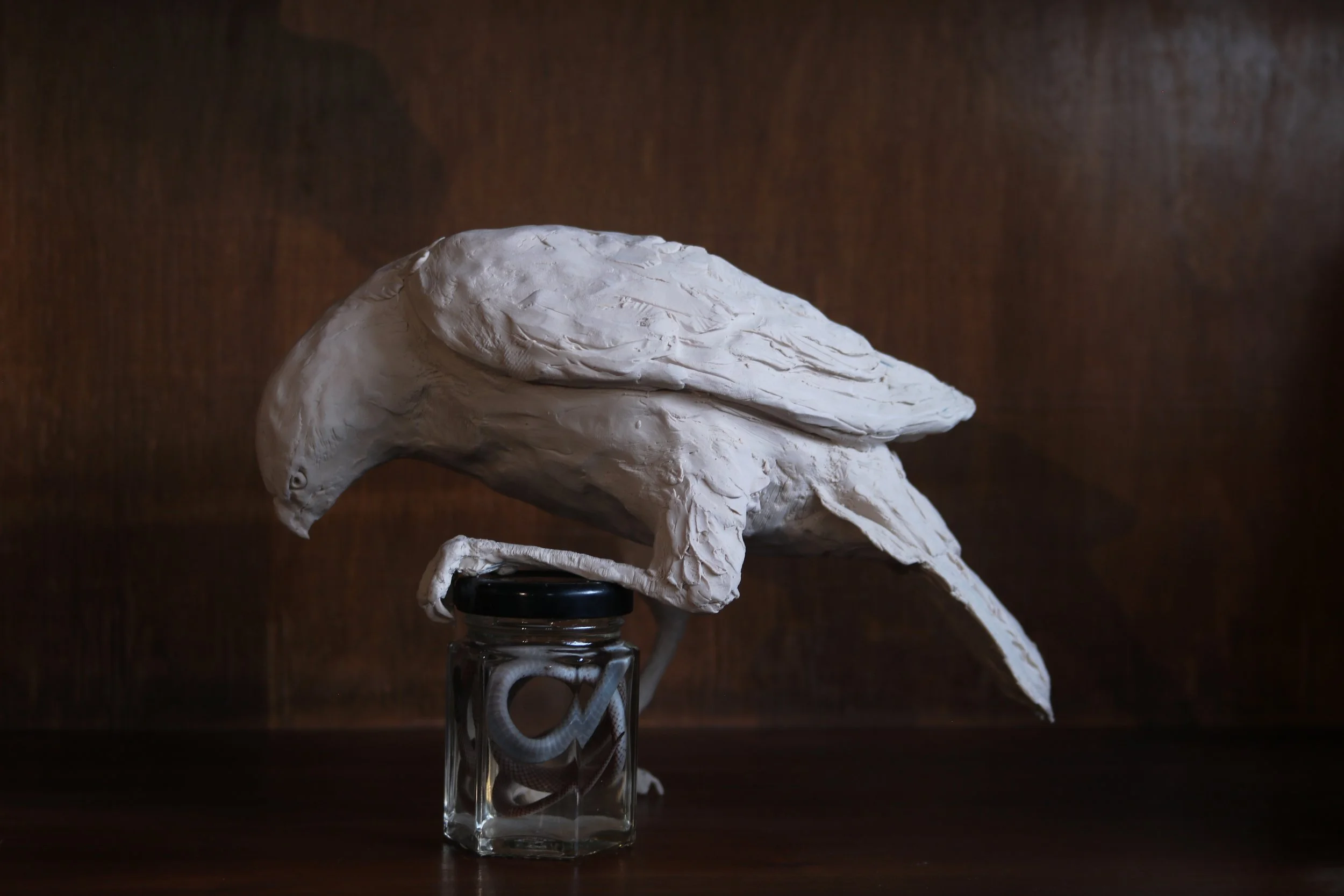
(left side view)
“KILL IT FOR THE MOUTHFEEL” (title inspired by artist Matt Adrian [1]) is an artwork consisting of two 3D objects: a goshawk sculpture made from polymer clay, and a ‘wet specimen’ Gould’s Hooded Snake in a glass jar with formaldehyde.
I found the snake first, dead in the shed at the horse yards. I decided to keep it, as I thought it would be a great opportunity to do something interesting for this unit’s project. I placed it in my freezer until I knew what I would do. I found inspiration in the Pink Chicken Project, with its statements about the Anthropocene and “the current devastation of the planet”[2]. After further research and thought, I decided on a piece surrounding the human impact on the environment when interacting with nature through art and science. I thought about how, by taking this dead snake out of the environment, I have in some way disrupted a natural process, as I am not allowing the body to decompose or be eaten, perhaps by a bird of prey in the area. I thought about how many of us claim to care about nature, but neglect to consider all the nuances and sacrifices that come with truly caring.
When it comes to nature, it isn’t often that you will come across an individual who claims not to care for it. Most of us, in one way or another, do. What my artwork “KILL IT FOR THE MOUTHFEEL” questions is where the line between true ‘care’ and simple ‘curiosity’ lies within mankind’s relationship with nature. There is also the question of what the term ‘nature’ means. Are humans a part of nature? What about domesticated animals, agriculture, gardens? Where does this division lie? Is civilisation the antithesis of nature, or a result of it?
If it is natural for a spider to weave a web, is it unnatural, then, for humans to build houses? When ‘nature’ itself is such a complex term, how can one determine what it means to care about it?
“KILL IT FOR THE MOUTHFEEL” ponders the relationship humans have with nature, manifested primarily through science and art. Discussing the Anthropocene, Jeremy Mynott in The Story of Nature writes, “the success of science… has meant that we have progressively acquired the means to control [nature]—and now to change it, or even destroy it.”[3] The now undeniable impact that mankind has on nature has “sharpened the division”[4] between us and it, but perhaps also blurred it further. Indeed, science can be used to destroy nature, but also to preserve and protect it. As for art, Mynott claims that “our imaginative responses to nature have always been as important as our scientific understanding of it… the two modes are complementary rather than conflicting.”[5] Art has a crucial role in expressing and enriching meanings of nature, but like science, it can be equally helpful and harmful. For example, the ethics of using animal bodies/materials in art is long debated. In a presentation on the ethics of animal bodies in taxidermy art, artist Mark Dion talks about the different meanings that animals can represent; from specimens standing in for scientific endeavour, to allegories, metaphors, symbols for other ideas.[6] Discussing one of his works, Survival of the Cutest, Dion talks about the want to “protect the charismatic megafauna, and not to protect the environments [or] things that we wouldn’t want to hug.”[7] There is importance in acknowledging that the conservation of “charismatic megafauna” relies on the protection of whole environments and less aesthetic animals alike.
As an example, the hawk, represented in my artwork, depends on the continuation of lower-status creatures, such as snakes, insects and rodents, to survive. Therefore, to care about the survival of certain animals, one must care also about its surrounding ecosystem, lest this care devolve into nothing more than detached curiosity. The raw, unpainted and unpolished form of the sculpture aligns with thoughts about the often ‘uncivilised’ and ‘ugly’ truths of nature, as well as the ephemeral state of many endangered or extinct species.
The snake specimen in my work represents a “trophy” of sorts: an emblem of the hunter’s pride.[8] For the bird of prey, this trophy of the hunt is crucial for survival. It is the main objective of every day to survive. For the human, it is a “trophy” of personal achievement—of wonder, taste, the success of a scientific endeavour. It is no longer a means of survival, no longer a meal. It is now an object of curiosity. By taking this snake (found dead) and placing it in a jar of chemicals, I have transformed an animal body from a part of a natural process, into a subject of art and scientific investigation.
[1] MATT ADRIAN, “MATT ADRIAN,” MATT ADRIAN, 2023, https://www.mattadrian.com/work.
[2] Nonhuman Nonsense, “Pink Chicken Project,” Nonhuman Nonsense, 2018, https://nonhuman-nonsense.com/pink-chicken-project.
[3] Jeremy Mynott, “Introduction: The Meanings of Nature,” in The Story of Nature: A Human History (New Haven: Yale University Press, 2024), 13, https://ebookcentral.proquest.com/lib/uwa/detail.action?docID=31625982..
[4] Mynott, “Introduction,” 13.
[5] Mynott, “Introduction,” 13.
[6] Brown University, “Mark Dion & Robert Marbury - Playing with Dead Things: The Ethics of Animal Bodies in Art,” Youtube.com, March 18, 2016, https://www.youtube.com/watch?v=X31Vf_S37_k&t=1431s.
[7] Ibid.
[8] Ibid.